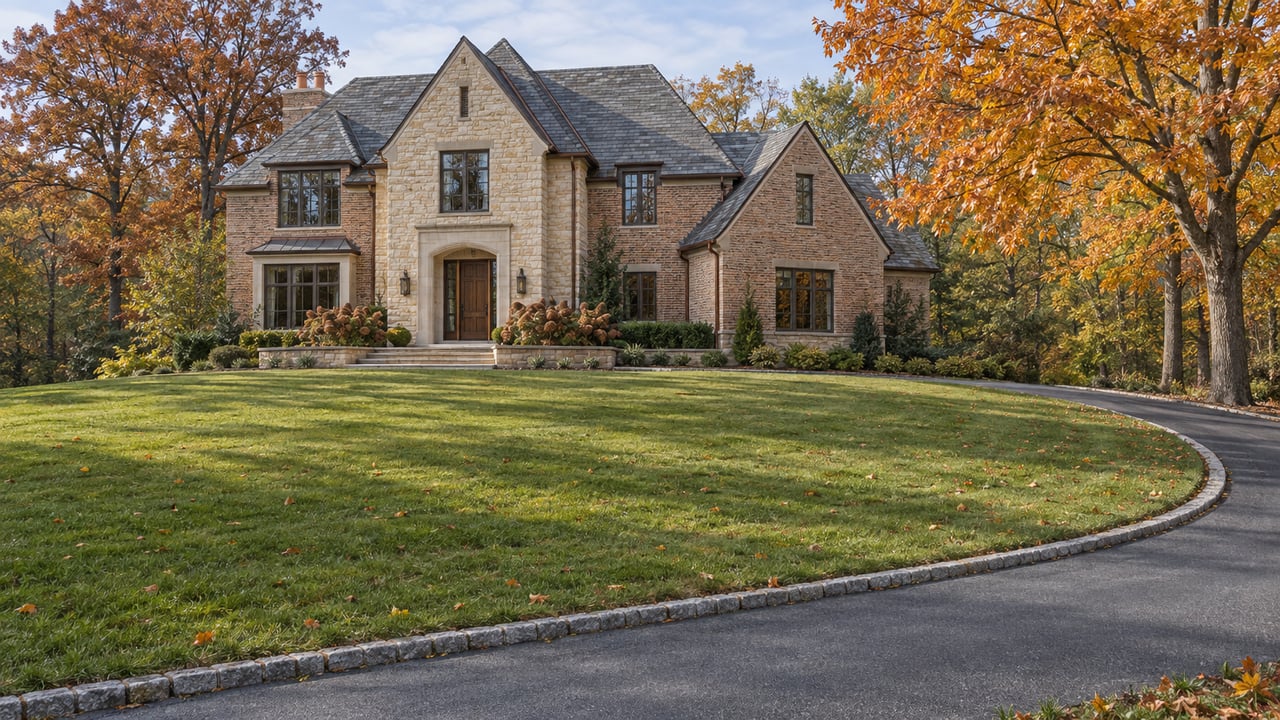
Moreland Hills has had patchy home internet for a simple reason. Its homes are too far apart for a provider to wire every one of them on its own. In December 2025, the village's broadband consultant counted 1,405 addressable locations inside village limits. Of those, 1,330 had no existing fiber. Covering the rest would take about 39.2 miles of new fiber, which works out to roughly 34 locations for every mile of cable.
That ratio of locations per mile explains why the village set aside a one-time $1.1 million of its own reserves to bring fiber to every home. It also explains why, until that network is built and confirmed, internet quality in Moreland Hills depends on the address. Two houses a few minutes apart can have very different service, and the listing price won't tell you which is which.
Why AT&T Is Already Wiring Some Streets
The first sign of the gap is that fiber is already showing up in parts of the village. At a February 4, 2026 Council Committee of the Whole meeting, a council member noted that AT&T had kept building on its own and was covering many of the main streets. Mayor Ethan Spencer said the company had reached under 20% of homes and was "picking areas where they are much denser." The minutes record that at that pace, it would take years.
That is how a provider behaves when it pays for every foot of cable itself. It builds first where homes sit close together, and the long wooded roads wait. Buyers touring homes in the village this fall are seeing the results of that order. A house on a main road may already have fiber. A house set back on a quieter road may not.
What It Costs to Run Fiber Past One House
The consultant, Reid Consulting Group, framed the issue around "cost to pass." That is the cost to run fiber past one location so the home can connect if the owner wants it. Its example assumed $100,000 per mile of construction. At 20 locations per mile, that comes to $5,000 per location. At 70 per mile, it drops to $1,429. The deck gives a typical provider threshold of $1,000 to $3,000 per location and places Moreland Hills on that same scale. At 34 locations per mile, the village sits near the top of what a provider will usually pay, and in some scenarios above it.
The deck then priced the whole village at several per-mile construction costs. It assumed a provider would put in $1,500 per location and treated the rest as the gap the village would have to cover:
| Cost per mile | Total cost to pass 39 miles | Cost per location | Gap per location | Total village gap |
|---|---|---|---|---|
| $60,000 | $2.3M | $1,759 | $259 | $0.3M |
| $80,000 | $3.1M | $2,346 | $846 | $1.1M |
| $100,000 | $3.9M | $2,932 | $1,432 | $1.9M |
| $120,000 | $4.7M | $3,519 | $2,019 | $2.7M |
Source: Moreland Hills public broadband meeting presentation, December 4, 2025.
A footnote on that slide says "the Gap expresses the subsidy required by the Village" and that both bidders requested a similar subsidy. The $1.1 million the village committed matches the $80,000-per-mile row. In plain terms, Moreland Hills offered to pay the difference between what wiring its low-density streets costs and what a provider would spend on its own.
The village's income level doesn't change this. A provider decides where to build based on how many locations it passes per mile, so a village made up mostly of large lots on winding roads ends up short on fiber whatever its homes are worth.
What Residents Had Before
The same presentation summed up current service as "quite a mix of speed test results with some locations still testing very poorly" and "overall not great Internet in the Village." Using Ookla speed-test data at the census-block level, the consultant found no blocks in the village averaging above 200 Mbps download and 50 Mbps upload. Many blocks had acceptable downloads but slow uploads, a pattern the deck called "common for cable modem services."
Slow uploads matter most for video calls, sending large files and cloud backups. That fits where the project came from. According to the Chagrin Valley Times, Mayor Spencer said it grew out of resident requests and a survey he ran after taking office, because many residents work from home and many professionals use a lot of data. The paper also reported his point that "there has been a lack of full coverage throughout the village," with the topography creating dead spots. The same report listed Charter Communications, Spectrum and Verizon among current providers, with AT&T then serving a small share of the village.
How the Village Chose a Provider
Moreland Hills issued its request for proposals on August 7, 2025, to every internet provider operating in the area. Two responded, AT&T and Chagrin Valley Gig, the locally owned provider that already serves Hunting Valley and was in the middle of a fiber project in Gates Mills. Spectrum, according to the presentation, "expressed interest in better serving the Village but did not respond to the RFP."
On cost, the two bids came out nearly the same. Each listed a $1.1 million village investment, and both proposed the same current fiber technology, XGS-PON. The bids differed mainly in timing and in how the fiber would be installed:
- Timeline. AT&T's December 2027 finish was listed as a "firm contractual commitment." Chagrin Valley Gig's schedule put Moreland Hills after Gates Mills and Kirtland, finishing in July 2030, and marked it subject to change.
- Installation. AT&T proposed adding fiber to its existing copper cables on poles, within existing rights-of-way and easements. Chagrin Valley Gig proposed boring underground, using the public right-of-way plus new private easements.
- Equipment. The deck noted that underground construction would put vaults in yards and along the right-of-way, while AT&T would mount most equipment on existing poles.
Timing settled the choice. "The deployment timing was a big deal," Mayor Spencer told the Chagrin Valley Times. The paper reported that AT&T plans to invest $2.2 million of its own, that the new lines will run wherever lines run today, mostly overhead, and that newer neighborhoods will have buried lines. Service would be voluntary and billed at AT&T's national pricing, with a basic package cited at $45 a month.
What the Public Record Confirms as of October 2026
This is where buyers need to be careful. The authorizing legislation, Ordinance 2026-09, would let the mayor sign a Fiber Construction Agreement with AT&T Services, Inc. The village's March 2026 newsletter lists it as "Placed on Second Reading." We have not found a later agenda, readable set of minutes or news report confirming a final vote, a signed contract or the start of village-wide construction. Council's next regular meeting is listed for October 14, 2026.
The February minutes show what was still being negotiated then. The first open point was the definition of "universal coverage," because it was not yet clear that Hiram House Camp, the schools and future homes were included. The second was making sure the contract incorporated Chapter 905 of the village's building code, which sets insurance, cleanup and other duties for contractors working in the right-of-way. The mayor also told council that AT&T had declined to lower the price for areas it had already built, saying it had factored that in when it priced the contract, and that no commitment existed for future technology upgrades. He described it as a system expected to last 25 to 30 years.
For buyers, that leaves a home's internet service in one of three situations:
- The street already has AT&T fiber from the company's own build-out.
- The street has cable or other existing service and is waiting on the village-wide build, which is targeted for December 2027 if the agreement goes ahead as proposed.
- The home sits on a road with weak coverage, where the gap described in the December 2025 speed tests is still the day-to-day reality.
Provider availability is checked by street address, so two homes in the same village can land in different situations. In a market where buyers already weigh lot size, setback and privacy, current internet service belongs on the same list of things to confirm before you commit.
A Few Questions Buyers Ask
Does the village plan bring fiber into each house? The plan described to the Chagrin Valley Times puts fiber in front of every village home. Each homeowner decides whether to connect and pay the monthly fee.
Will this improve cell coverage? No. The mayor said the project covers fiber internet only, and that the village is working separately with carriers on cell service.
Is Spectrum upgrading too? The Chagrin Valley Times reported the mayor's statement that Spectrum intends to invest in better service and speeds in 2027, and his expectation that more competition will lower prices for residents.
If you're comparing homes in Moreland Hills and remote work is part of your plans, Adam Kaufman and his team will help you confirm each address's current internet service and follow the fiber agreement as council acts on it, so you know what you're getting before you make an offer. Just Ask Adam.
This article is general information, not legal, tax or financial advice. Consult a qualified professional about your situation.